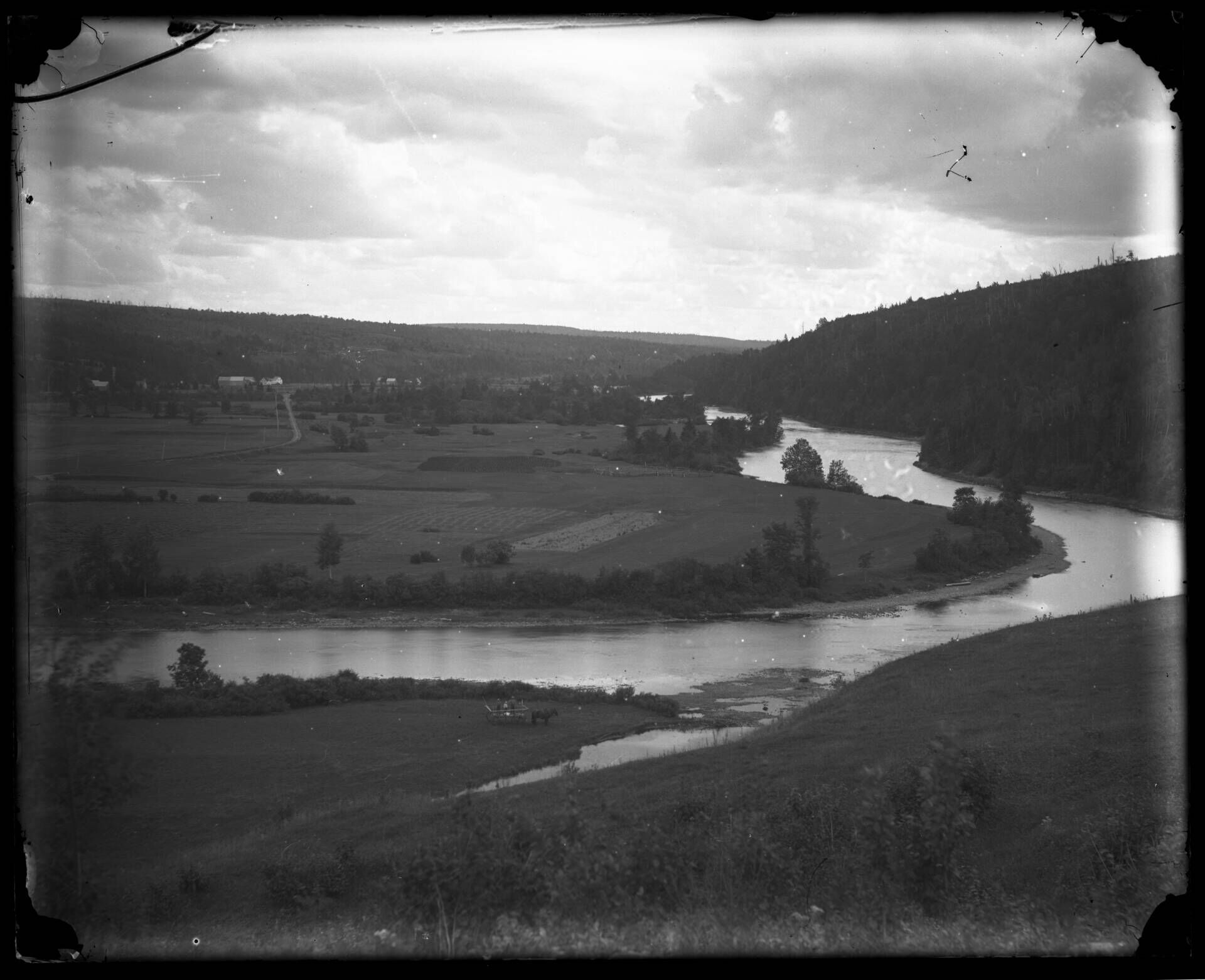
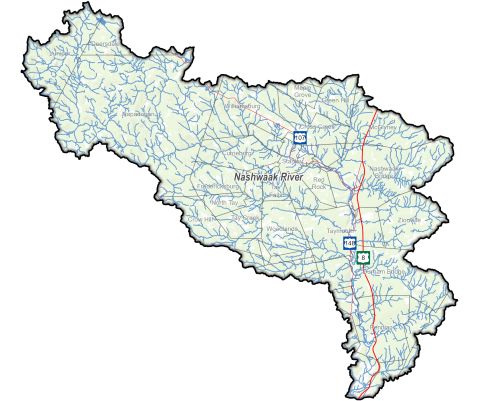
The Nashwaak River flows from the Nashwaak Lake, northwest of Stanley, to the Wolastoq (Saint John River) on the north side of Fredericton. It travels over 110 km, draining the Nashwaak Watershed. The watershed covers 1,707 km of central New Brunswick.
NesuwahkikIn the Wolastoqey language, the name for the Nashwaak River is Nesuwahkik (Nah-wij’-e-wauk). It means halfway place. Other meanings include slow current and strong undercurrent. |
History
First settled over 10,000 years ago, the watershed is the traditional territory of the Wolastoqiyik People. They used the river for travel, and to access food and other resources. Portage routes to other watersheds were vital for trade and communication.
While the Wolastoqiyik People continued to live along the river, European colonization started in the 17th Century, with the arrival of Samuel de Champlain and French grant holders. Between 1691 and 1692, the French built a fort at the mouth of the Nashwaak River. Called Fort St. Joseph, it was more commonly known as Fort Nashwaak.
An attack by soldiers from New England was deflected in 1696. The fort was dismantled in 1700. Acadians remained at Pointe Sainte-Anne on the opposite side of the river, near present day Government House. This ended with the St. John River Campaign in 1759, when the area came under British control.
In 1783, the United Empire Loyalists arrived in New Brunswick, after fleeing the American Revolution. During the18th and 19th Centuries, agriculture and logging were the major industries along the river.
Today, paddling, tubing, and fishing are popular river past-times. Paddlers will continue to see logging and farming, in addition to protected floodplains, well-used trails, parks, an amphibian nature preserve, as well as the remnants of industrialization that occurred along the river.
Running the River
***See Points of Interest below.
Running the Nashwaak River takes paddlers past small communities, landmarks and various attractions. Paddlers can start their voyage in Stanley, part of the Nashwaak Rural Community. The community was founded on agriculture and forestry and is now home to the Stanley Fair.
Heading downriver, paddlers will glide past pastoral scenery, before arriving at Nashwaak Bridge. Here, find the festival site for the Nashwaak Music Fest that happens on the NB Day weekend.
Continuing along, paddlers will come to the community of Taymouth. Find a launch site here at the Taymouth United Church. If the day is right, there is also the Taymouth Community Market.
Near this location, paddlers can head on land to find a trail to Dunbar Falls. You will also see lots of people out enjoying tubing on the river.
Next stop is Durham Bridge RV Park, and then the Riverbend Golf Club.
The river next brings paddlers to Nashwaak Village and then Penniac, both former farming communities near Fredericton. At Penniac, enjoy a launch site for canoes, kayaks, etc. From here, the river speeds up a bit, passing though some rapids, before arriving at historic Marysville.
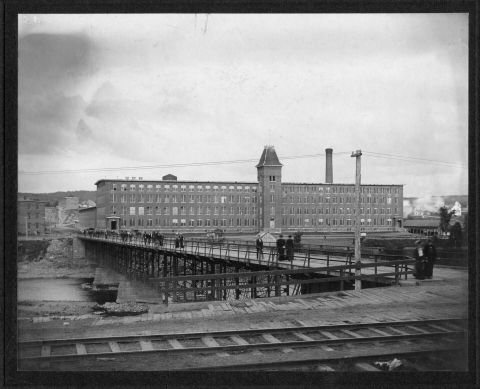
Marysville is a national historic site, founded by Alexander “Boss” Gibson. Here paddlers will find remnants of a thriving community build around a cotton mill and forestry. See the special section on this web page.
Amongst the streets lined with a brick cotton mill and brick tenement houses, travellers will find The Landing, a popular coffee and bike shop, as well the Marysville Heritage Centre, where paddlers will find a launch site.
Heading on downriver, see flood plains that are being planted with trees to avoid erosion and control flooding. As the Nashwaak River flows into the Wolastoq (Saint John River), paddlers are surrounded by history and a view of downtown Fredericton.
At the mouth of the Nashwaak, plaques and landmarks commemorate Fort Nashwaak, as well as the achievements of “Boss” Gibson. Visit the brick roundhouse used to turn around his trains from central New Brunswick.
The building is now used a craft brewery, coffee shop and restaurant. craft beer pub and restaurant operated by the Picaroons Brewing Company. Just down the road, find Cannon’s Cross Pub. From both locations, look out over the Wolastoq (Saint John River) and think about life well crafted.
Visitors can also journey across the old train bridge, now a walking bridge, that the “Boss” helped build. Or head into Carleton Park.
From this location, head out on the city’s extensive trail system, connecting users to over 120 km of trails. Learn more about three with Wolastoq names.
Got some extra time, stop at Hyla Park Nature Preserve, Canada’s first amphibian park, celebrated the gray tree frog. Nearby, visitors will also find the urban community of Sitansisk (St. Mary’s First Nation).
Marysville
Most notable in this regard is Marysville. This was the community created by Alexander “Boss” Gibson, and named after his wife, Mary. Here he established a cotton mill, a lumber mill, and railway lines into Central New Brunswick and Maine, USA. A generous man, he built a store, church, and brick homes for his workers.
At the mouth of the Nashwaak, he built a roundhouse to turn around the trains that brought goods to the area. The Boss also had boats, which were built near the roundhouse. At the height of his career, he was one of Canada’s richest men. With changing national policies, his business failed. He sold the mill in 1908.
Nonetheless, he left an important legacy of railway and industrial infrastructure in his province. He is a National Historic Person, and Marysville is a National Historic District. The homes he built for his workers remain. The old cotton mill has been repurposed into government offices. And the railway roundhouse is now a popular craft brewery called Picaroons. He is buried in the Gibson United Church graveyard.
Resources
- Nashwaak Watershed Association
- Nashwaak Rural Community
- Fredericton Capital Region Tourism
- Sitansisk (St. Mary’s First Nation)
Points of Interest
- Marysville Historic District, National Historic Site of Canada
- Alexander "Boss" Gibson, National Historic Person
- Fort Nashwaak (Naxoat), National Historic Site of Canada
- The Battle Of Fort Nashwaak, Backyard History, Andrew MacLean
- Carleton Park
- Picaroons Brewing Company
- Fredericton Trails
- Hyla Park Nature Preserve