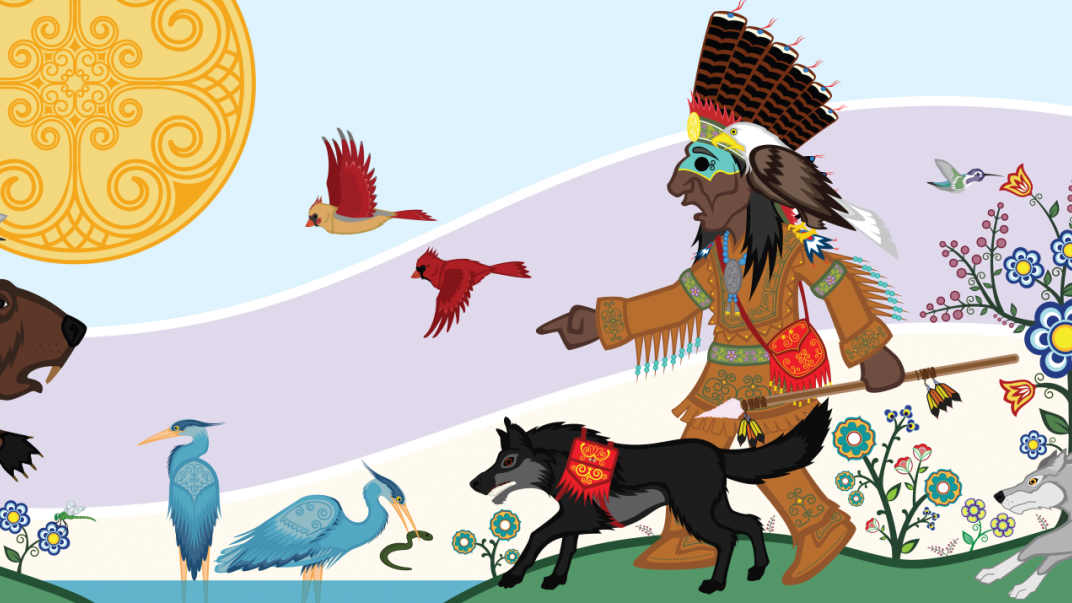
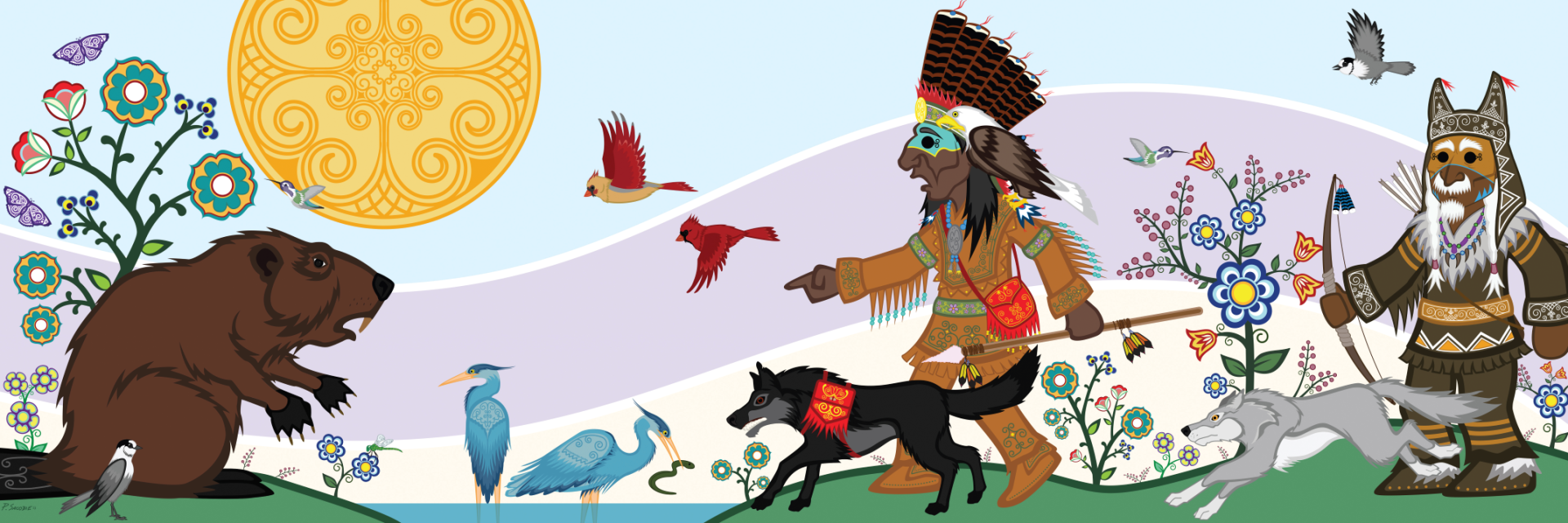
The mural is centred around the ancient Wolastoqey story of Glooscap and the Giant Beaver - a
story shared orally for over 300 generations, but one that fell silent over the last century. At the
centre of the artwork is Glooscap, the cultural hero and deity figure of the Wabanaki (a
confederacy of the Mi’kmaq, Wolastoqiyik, Passamaquoddy, Penobscot, and Abenaki
Indigenous peoples, who live in Atlantic Canada and New England). Glooscap was responsible
for taming large beasts and shaping the landscape in these regions. Behind him in the mural is
his older brother Mikumsesu, and surrounding them are local flora and fauna.
The story recalls how Glooscap helped the Wolastoqey people outlast floods and make
their land more hospitable many thousands of years ago by destroying a huge beaver dam at
the mouth of the Wolastoq (St. John River) and shrinking the giant beaver to its present size.
Once he did so, the water levels went down, creating Grand Lake and other geographical
features along the beautiful river valley. Glooscap and Mikumsesu’s clothing references
traditional Wolastoqey dress, such as Glooscap’s vertically-feathered Chief headpiece, as well
as small double-curve decorative motifs throughout.
During the last ice age, the Maritime provinces were covered by an ice sheet up to a
kilometre thick. When this ice began to melt, around 15,000 years ago, a massive freshwater
lake soon filled the Wolastoq/St. John River valley – including where you are currently standing
– spanning as far as the eye can see. This was held by an enormous dam of ice and natural
materials near Saint John. Archaeological evidence shows that Indigenous peoples inhabited
this region when the ice dam was present and lived among giant beavers which are now
extinct. Once the dam broke and the waters slowly receded to present levels, the people
moved to the new water’s edge.
Local Indigenous peoples explained these lived experiences through story and memory
which have been passed down for thousands of years. The artist dedicates this mural to his
ancestors who kept the stories alive.
Artist Percy Sacobie of Sitansisk (St. Mary’s First Nation) uses his Wolastoqey culture, traditions,
story, and language as inspiration for his art. He works in many mediums, including wood,
beads, paint, and computer graphics.